Hi, I am Yang Tian (田阳) 👋

I am a Ph.D. candidate in Artificial Intelligence at Shandong University, advised by Prof. Liqiang Nie. Before that, I received my M.Sc. in Computer Science from the University of Augsburg, Germany, advised by Prof. Björn Schuller, and my B.Eng. in Software Engineering from Nanjing University of Aeronautics and Astronautics. Previously, I was an algorithm intern at the Large Language Model Center of Kuaishou Technology (2024.09 – 2026.05).

My research interests mainly focus on Multimodal Retrieval Agents (context management and long-horizon interaction), Multimodal Retrieval-Augmented Generation (RAG), and billion-scale Approximate Nearest Neighbor Search (ANNS).

🔥 News

  • 2026.07.10🎉🎉 Two papers are accepted by ACM MM 2026 (MM-ContextFold as Oral, FIG as Poster)!
  • 2025.06.16🙋 I was accepted as a student volunteer for ACL 2025.
  • 2025.05🎉 One paper (CoRe-MMRAG) is accepted by ACL 2025 Main!

📝 Publications

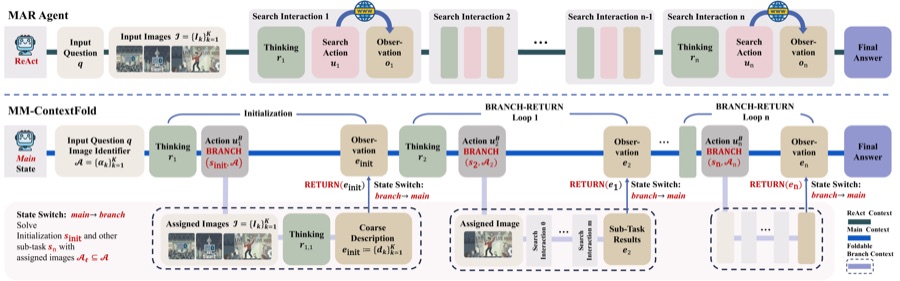
Overview of the MM-ContextFold framework
ACM MM 2026 Oral

MM-ContextFold: Context Folding for Multimodal Agentic Retrieval

Yang Tian, Fan Liu, Jingyuan Zhang, Zhenyang Li, Yupeng Hu, Liqiang Nie

Abstract

Multimodal Agentic Retrieval (MAR) requires agents to iteratively invoke search tools over multimodal inputs across extended tool-use trajectories. Prevailing frameworks such as ReAct append raw input images and full interaction histories to a single ever-growing context, causing context saturation. Through a systematic empirical study over ~10,000 retrieval trajectories, we find that the agent's reliance on raw images progressively diminishes as visual cues are textualized into the evolving context, while continued image retention brings redundant visual context and neutral or worse accuracy. Motivated by these findings, we propose MM-ContextFold, a training-free dual-state framework that decouples visual grounding from the main reasoning trajectory: a persistent text-only main context handles high-level planning, while ephemeral branch contexts load only the designated raw images for scoped visual grounding; each branch folds its findings back into the main context as a textual summary, after which the raw images are discarded. Across seven MAR benchmarks and five backbones, MM-ContextFold improves average accuracy by 6.3% over ReAct while reducing working context length by 27.5%.
Overview of the FIG framework
ACM MM 2026

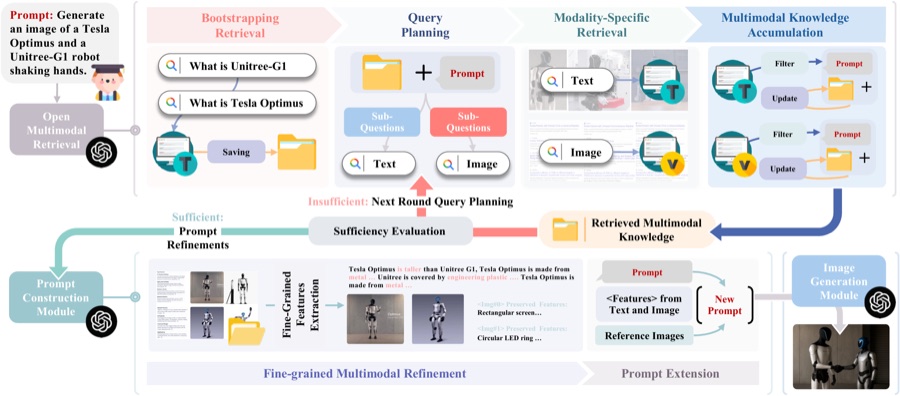
Open Multimodal Retrieval-Augmented Factual Image Generation

Yang Tian, Fan Liu, Jingyuan Zhang, Wei Bi, Yupeng Hu, Liqiang Nie

Abstract

Large Multimodal Models generate photorealistic and prompt-aligned images, but often produce outputs that contradict verifiable knowledge, especially when prompts involve fine-grained attributes or time-sensitive events. We formalize Factual Image Generation (FIG), an open-world generation task where the input prompt specifies only a coarse intent while many image-critical facts remain implicit and must be inferred and grounded in verifiable real-world knowledge, characterized along three dimensions: perceptual fidelity, compositional consistency, and temporal consistency. We propose an agentic open multimodal retrieval-augmented framework for image generation that iteratively plans sub-queries, retrieves modality-specific evidence from the open web, filters it through sufficiency evaluation and cross-modal filtering, and incrementally distills the refined knowledge into enriched prompts. To support systematic evaluation, we build FIG-Eval, a benchmark of 514 knowledge-intensive prompts spanning ten entity classes with 4,093 human-annotated question-answering items. Experiments show that our framework substantially improves factual consistency and overall image quality over strong baselines.

Overview of the CoRe-MMRAG framework
ACL 2025 Main

CoRe-MMRAG: Cross-Source Knowledge Reconciliation for Multimodal RAG

Yang Tian, Fan Liu, Jingyuan Zhang, Victoria W., Yupeng Hu, Liqiang Nie

Abstract

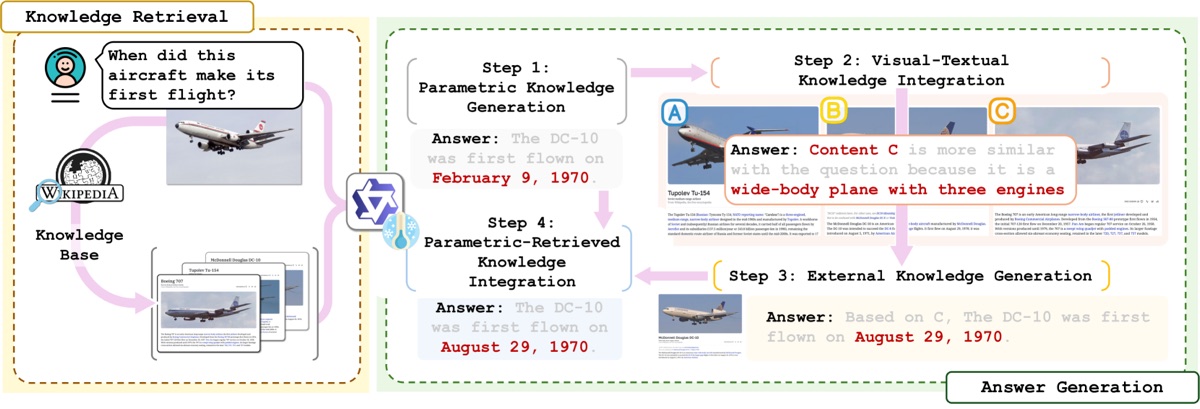
Multimodal Retrieval-Augmented Generation (MMRAG) has been introduced to enhance Multimodal Large Language Models by incorporating externally retrieved multimodal knowledge, but it introduces two challenges: Parametric-Retrieved Knowledge Inconsistency (PRKI), where discrepancies between parametric and retrieved knowledge create uncertainty in determining reliability, and Visual-Textual Knowledge Inconsistency (VTKI), where misalignment between visual and textual sources disrupts entity representation. To address these challenges, we propose Cross-source knowledge Reconciliation for Multimodal RAG (CoRe-MMRAG), a novel end-to-end framework that effectively reconciles inconsistencies across knowledge sources. CoRe-MMRAG follows a four-stage pipeline: it first generates an internal response from parametric knowledge, then selects the most relevant multimodal evidence via joint similarity assessment, generates an external response, and finally integrates both to produce a reliable answer. Additionally, a specialized training paradigm enhances knowledge source discrimination, multimodal integration, and unified answer generation. Experiments on KB-VQA benchmarks show that CoRe-MMRAG achieves substantial improvements over baseline methods, achieving 5.6% and 9.3% performance gains on InfoSeek and Encyclopedic-VQA, respectively.

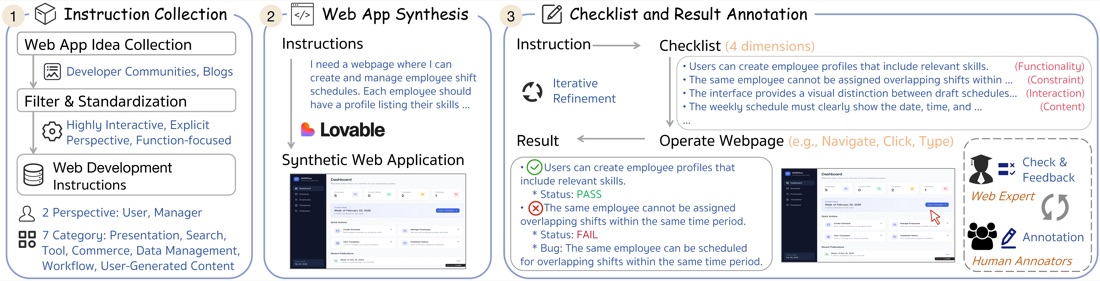
WebTestBench data construction pipeline
Preprint

WebTestBench: Evaluating Computer-Use Agents towards End-to-End Automated Web Testing

Fanheng Kong, Jingyuan Zhang, Yang Yue, Chenxi Sun, Yang Tian, Shi Feng, Xiaocui Yang, Daling Wang, Yu Tian, Jun Du, Wenchong Zeng, Han Li, Kun Gai

Abstract

The emergence of Large Language Models (LLMs) has catalyzed a paradigm shift in programming, giving rise to "vibe coding", where users can build complete projects and even control computers using natural language instructions. This paradigm has driven automated webpage development, but it introduces a new requirement about how to automatically verify whether the web functionalities are reliably implemented. Existing works struggle to adapt, relying on static visual similarity or predefined checklists that constrain their utility in open-ended environments. Furthermore, they overlook a vital aspect of software quality, namely latent logical constraints. To address these gaps, we introduce WebTestBench, a benchmark for evaluating end-to-end automated web testing. WebTestBench encompasses comprehensive dimensions across diverse web application categories. We decompose the testing process into two cascaded sub-tasks, checklist generation and defect detection, and propose WebTester, a baseline framework for this task. Evaluating popular LLMs with WebTester reveals severe challenges, including insufficient test completeness, detection bottlenecks, and long-horizon interaction unreliability. These findings expose a substantial gap between current computer-use agent capabilities and industrial-grade deployment demands. We hope that WebTestBench provides valuable insights and guidance for advancing end-to-end automated web testing.

Technical Report

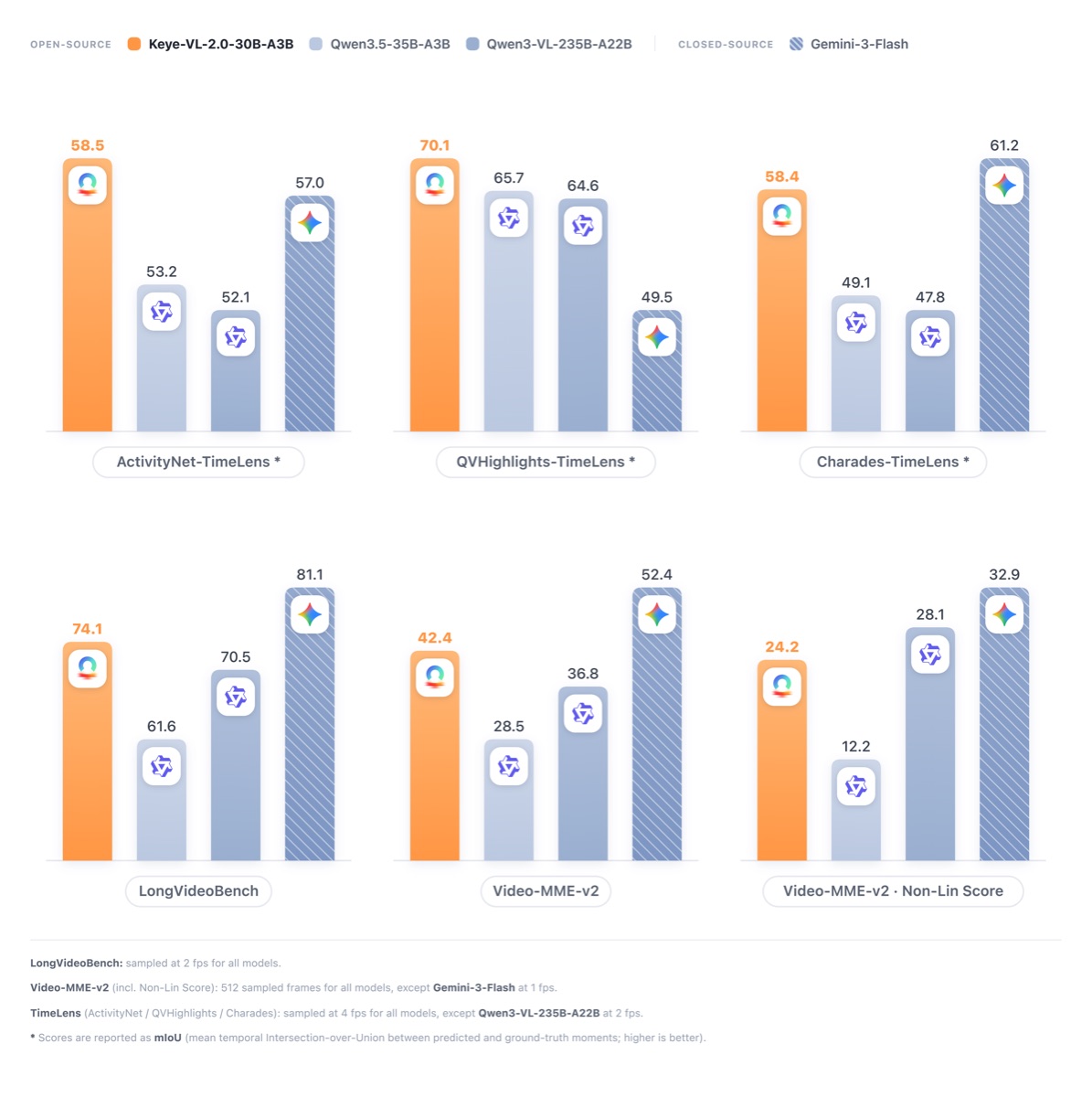
Keye-VL-2.0-30B-A3B performance on video understanding benchmarks
Tech Report

Kwai Keye-VL-2.0 Technical Report

Kwai Keye Team (incl. Yang Tian)

Abstract

We introduce Kwai Keye-VL-2.0-30B-A3B, an open-source Mixture-of-Experts (MoE) multimodal foundation model designed to advance long-video understanding and agentic intelligence. To address the challenges of ultra-long contexts, information redundancy, and prohibitive computational costs inherent in hour-level videos, Keye-VL-2.0 is the first to adapt DeepSeek Sparse Attention (DSA) to GQA-based multimodal architectures, enabling lossless 256K context processing while capturing critical frames and long-range temporal dependencies. This architecture is underpinned by a highly optimized training and inference infrastructure, including scalable video I/O, heterogeneous ViT-LM parallelism, and custom DSA kernels that significantly maximize throughput and minimize computational overhead. Furthermore, to overcome the algorithmic dilemma of catastrophic forgetting during multi-task alignment, we introduce Cross-Modal Multi-Teacher On-Policy Distillation (MOPD) paired with Context-RL and Video-RL. By distilling dense token-level teacher feedback from on-policy rollouts back into the MoE backbone, which activates only 3B parameters, Keye-VL-2.0 natively empowers advanced agent collaboration across Code, Tool, and Search scenarios with multimodal self-correction. Extensive evaluations across video understanding, temporal grounding, reasoning, STEM, and agent benchmarks demonstrate that Keye-VL-2.0-30B-A3B achieves state-of-the-art performance among models of similar scale, particularly excelling in fine-grained temporal localization on TimeLens and long-video comprehension on Video-MME-v2 and LongVideoBench. We release our model checkpoints to accelerate community progress toward scalable and robust multimodal agentic applications.

💻 Open Science

🏭 Industry Project

SDU–Huawei Collaboration: Large-Scale Vector Retrieval (ANNS)

🌟 Huawei Excellent Technical Cooperation Project Award (2023, project member) 🏆 QSNGT: leading performance on 5 international benchmarks
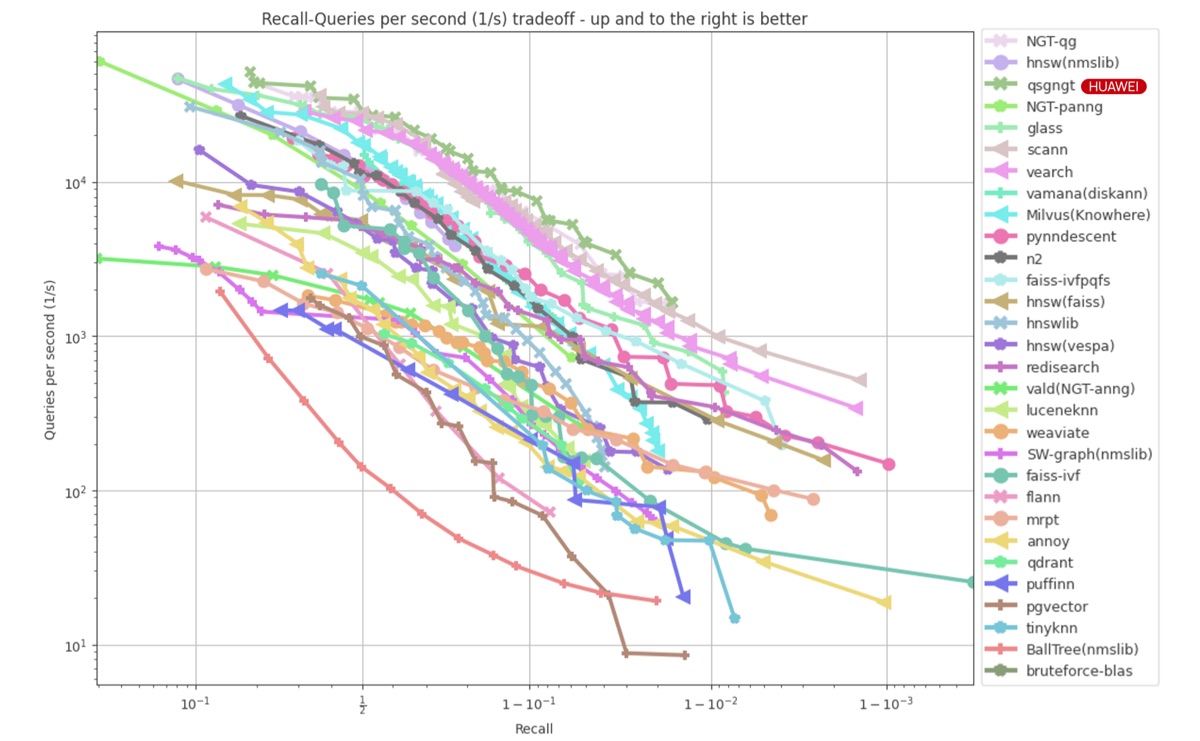
QSGNGT on the ANN-Benchmarks Recall-QPS evaluation

As a member of the SDU–Huawei vector retrieval collaboration (2022.07 – 2024.08), I co-proposed QSNGT, a graph-tree-based vector retrieval algorithm with improved edge-selection and index-construction strategies, achieving leading performance on five international benchmark datasets. I also designed a billion-scale inverted-index construction algorithm that improves construction efficiency by over 50% without loss of retrieval performance, and a locality-sensitive graph index for streaming search that improves retrieval performance by over 10% on four billion-scale datasets.

🔖 Patents

  • [Granted 2025.01] Image-Text Retrieval Method and System Based on Cross-Modal Semantic Parsing(基于跨模态语义解析的图文检索方法及系统)— Application No. 2024103264429 [Link]

🎖 Honors and Awards

  • 2025.06Student Volunteer, ACL 2025
  • 2025.01First-class Academic Scholarship, Shandong University
  • 2024.01Second-class Academic Scholarship, Shandong University
  • 2023Huawei Excellent Technical Cooperation Project Award (project member)
  • 2015.01Second-class Academic Scholarship, Nanjing University of Aeronautics and Astronautics

💼 Experience

  • 2024.09 – 2026.05Algorithm Intern, Large Language Model Center, Kuaishou Technology — multimodal agent training and retrieval-augmented generation
  • 2021.12 – 2022.05R&D Engineer, Inspur Academy of Science and Technology — low-power ML algorithms on edge devices

📖 Education

  • 2022.09 – 2026.12Ph.D. in Artificial Intelligence, Shandong University (expected)
  • 2017.09 – 2021.09M.Sc. in Computer Science, University of Augsburg, Germany
  • 2016.03 – 2017.06Preparatory Program (Studienkolleg), Otto von Guericke University Magdeburg, Germany
  • 2011.09 – 2015.06B.Eng. in Software Engineering, Nanjing University of Aeronautics and Astronautics

📃 Academic Services

  • Journal Reviewer: IEEE TMM, IEEE TKDE, IEEE TIP, IEEE TCSVT, ACM TOIS
  • Conference Reviewer: AAAI, ACM MM, ACL, CVPR